
The biggest AI mistake in companies? We throw the hardest work at the model and then wonder why it fails
"We'll deploy AI and everything will go twice as fast."
Energy is high, the roadmap is ready, and sometimes savings are already being planned.
Then Monday comes.
People still do routine work manually because "we know how to do it." And AI gets the hardest problems: unclear requirements, strategic ambiguity, high-risk decisions that even senior people would solve over several rounds.
After a few weeks, the familiar sentence appears: "AI is overrated."
The biggest issue is wrong work sequencing.
No, AI is not overrated. We just aimed priorities in the wrong direction.
The classic mistake: people keep routine, AI gets chaos
Many companies repeat the same inversion:
- routine operations stay with humans,
- the hardest topics are delegated to the model,
- when output is weak, the whole initiative is labeled a dead end.
This is like giving a trainee a crisis negotiation with a key client on day one and then writing an evening report that they are "not ready for business."
LLMs (language models that generate output from probability and context) are strong accelerators, but only when the task is clear, quality criteria are explicit, and human accountability stays in place.
AI does not replace leadership. It extends leadership capacity when work is sequenced well.
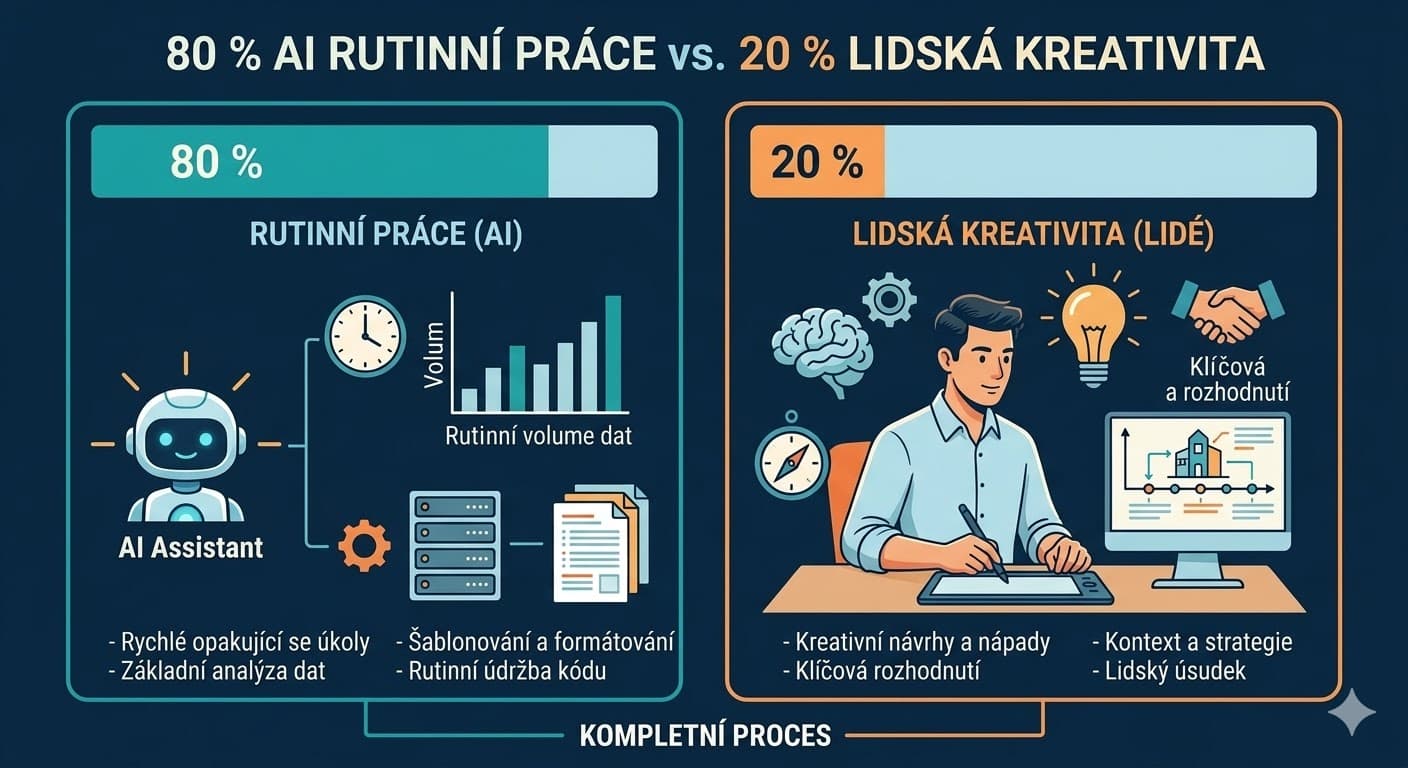
The model that works: 80/20
If you want real impact, reverse the order:
- Move 80% of routine work to AI
- Keep 20% for people: creativity, decision-making, and direction
Routine includes repeatable actions: first drafts, summarization, rewriting, prep materials, standard responses, checklists, and pre-processing.
That 20% is where competitive value appears: priority calls, business judgment, process design, risk handling, and alignment across teams.
People do not need to invent everything alone. They can think with AI. The difference is that final judgment remains human.
Why this is unpopular, even though it is logical
Because routine is comfortable.
It gives a sense of progress, quick checkmarks, familiar rhythm. When AI takes routine, people are left with harder work. Exactly the work everyone says they want: strategic, creative, accountable.
And this is where resistance appears.
Not because people refuse growth, but because role identity changes. It is no longer enough to just "complete a task." You must frame the problem, define quality, evaluate options, and defend decisions.
That is precisely what moves teams from operational mode to growth mode.
Two companies, two outcomes
One company started top-down and immediately pushed AI into complex strategic decisions without strong inputs. Prompts were long, vague, full of internal jargon. Output quality fluctuated. After a month, the verdict was: "This is not for us."
The other company did the opposite. They listed routine tasks first and tested each through three questions:
- does it repeat frequently?
- does it have a clear input and expected output?
- can quality be checked quickly?
Only then did they move those tasks into AI workflows (workflow = predefined sequence that keeps results consistent). More complex topics were added later, with AI as a sparring partner for options, not as an autopilot for final decisions.
The result? Not only faster operations, but also more senior capacity for work that had been postponed for months.
What this means for management
The biggest failure point is managerial: wrong rollout order.
If you want measurable impact, manage the shift with discipline:
- Map routine work across teams.
- Select tasks with high repeatability.
- Define what quality output means.
- Add human controls where risk is higher.
- Measure time, quality, defect rate, and released capacity.
Treat this as an operating model change, not a standalone AI initiative.
One technical detail that decides everything
Input quality.
Every model depends on three things: prompt (what you ask), context (what the model knows), and feedback (how correctness is evaluated). If any of these are weak, output consistency drops.
That is why simple rules work:
- templates for recurring prompt types,
- shared terminology,
- a library of strong output examples,
- regular evaluation of where AI truly saves time and where it only creates a productivity illusion.
Closing
Company performance will not improve by giving AI the hardest problem you cannot even describe clearly.
It improves when AI takes routine and people shift toward judgment, creativity, and accountability.
That is when the most important change happens: teams finally execute things that were postponed for years because operations always consumed all capacity.
Done well, this becomes a durable competitive advantage.
Send me your question
Have a question about the article or want to discuss a related topic? Send me your email and write your question.