
AI in Companies: when it truly helps and when it only creates the feeling of productivity
In recent months, I have been helping companies integrate generative AI into the work of developers and management.
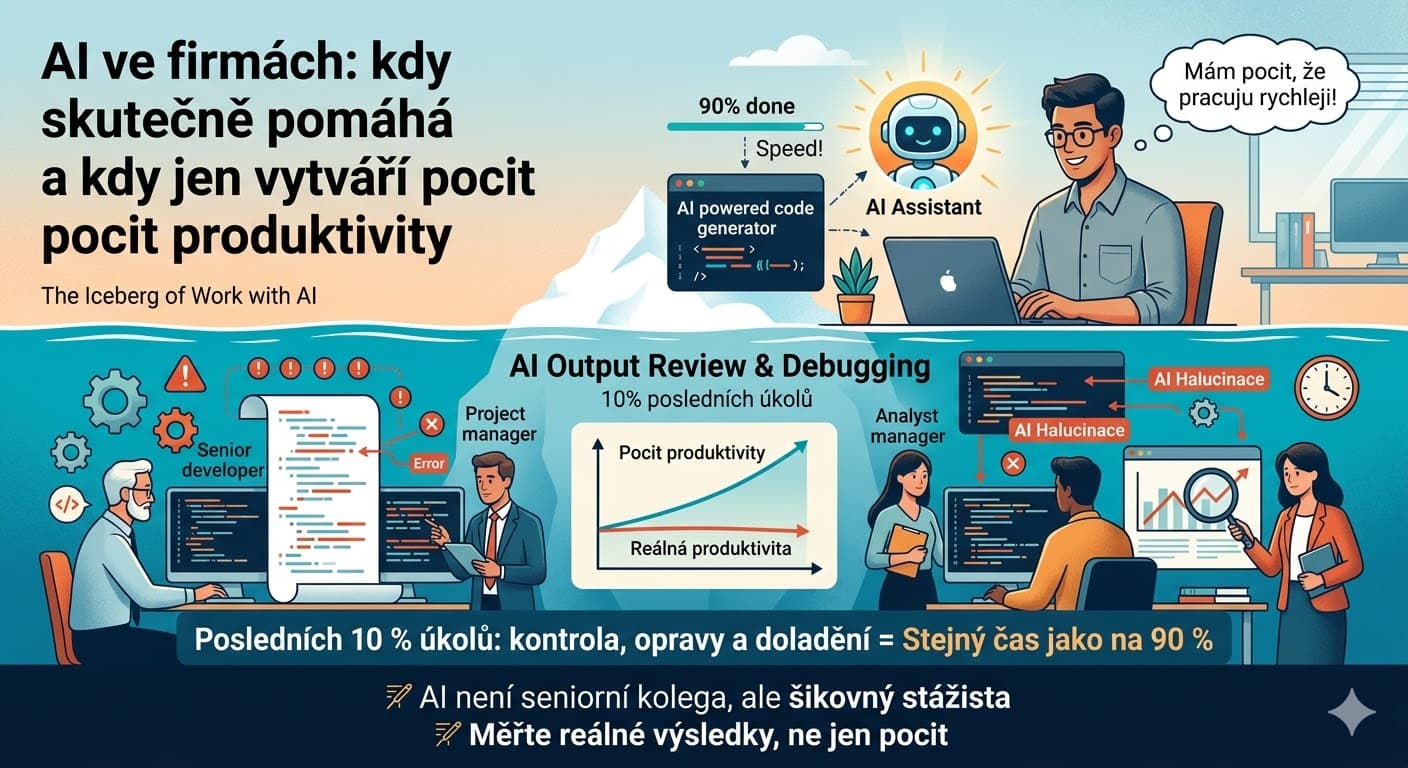
AI often does 90% of the work quickly, but the last 10% can consume all the savings.
One pattern keeps repeating: AI often completes 90% of the task fast, but the last 10% (review, fixes, and final polish) can take as much time as was "saved" before.
The result? Many people strongly feel they are working faster, but when measured more closely, real productivity often remains almost unchanged.
Both research and practical experience show that:
- company experiments with generative AI often have no clearly measurable impact,
- even experienced developers can end up slower with AI, despite feeling the opposite,
- AI performs best on shallow work (routine, repetitive tasks),
- for complex, creative, or strategic tasks, the benefit is much smaller and sometimes disappears entirely.
A major issue is that AI hallucinates with confidence: it invents facts, generates faulty code suggestions, or produces misleading arguments. That is why outputs must always be reviewed by an expert.
A useful metaphor: AI is a capable intern or assistant. It helps with drafts, brainstorming, and routine, but final accountability stays with the human.
How to approach AI in a company sensibly
1. Use AI only where you are the expert
So you can tell when AI is producing nonsense and when it is truly adding value.
2. Treat AI as a first-draft generator, not a final solution
Let it produce the first draft of code, email, analysis, or presentation, but take ownership of the final version yourself.
3. Automate routine, protect time for deep work
Delegate routine replies, rewriting, or summarization to AI. Complex decisions, architecture, strategy, and prioritization should remain human.
4. Measure real outcomes, not just the feeling of speed
Track time, quality, error count, and customer satisfaction. The feeling that "it somehow goes better" is not enough. Data matters.
Productivity remains a human task
AI can speed up the journey, but it cannot decide where to go.
Real added value appears when people:
- define goals and priorities clearly,
- know where to deploy AI and where not to,
- can critically evaluate and refine AI outputs.
Companies that treat AI as a smart tool, not a magical solution, are usually the ones that benefit from it the most in the long run.
Send me your question
Have a question about the article or want to discuss a related topic? Send me your email and write your question.